The retainer market is changing fast. Digital manufacturing has introduced new options that challenge decades of conventional lab practice — and clinics that understand the differences are better positioned to give patients the right recommendation. Here's a clear, clinical comparison of both methods.
How Traditional Retainers Are Made
Conventional removable retainers — typically Hawley or vacuum-formed — start with a physical impression. Alginate or PVS material captures the arch, the impression is poured in plaster, and the retainer is fabricated directly over the stone model.
For fixed retainers, the orthodontist usually bends a wire chairside and bonds it directly, or sends a plaster model to the lab where the wire is adapted manually. It's a process that relies heavily on the technician's skill and the quality of the physical model.
Traditional Workflow
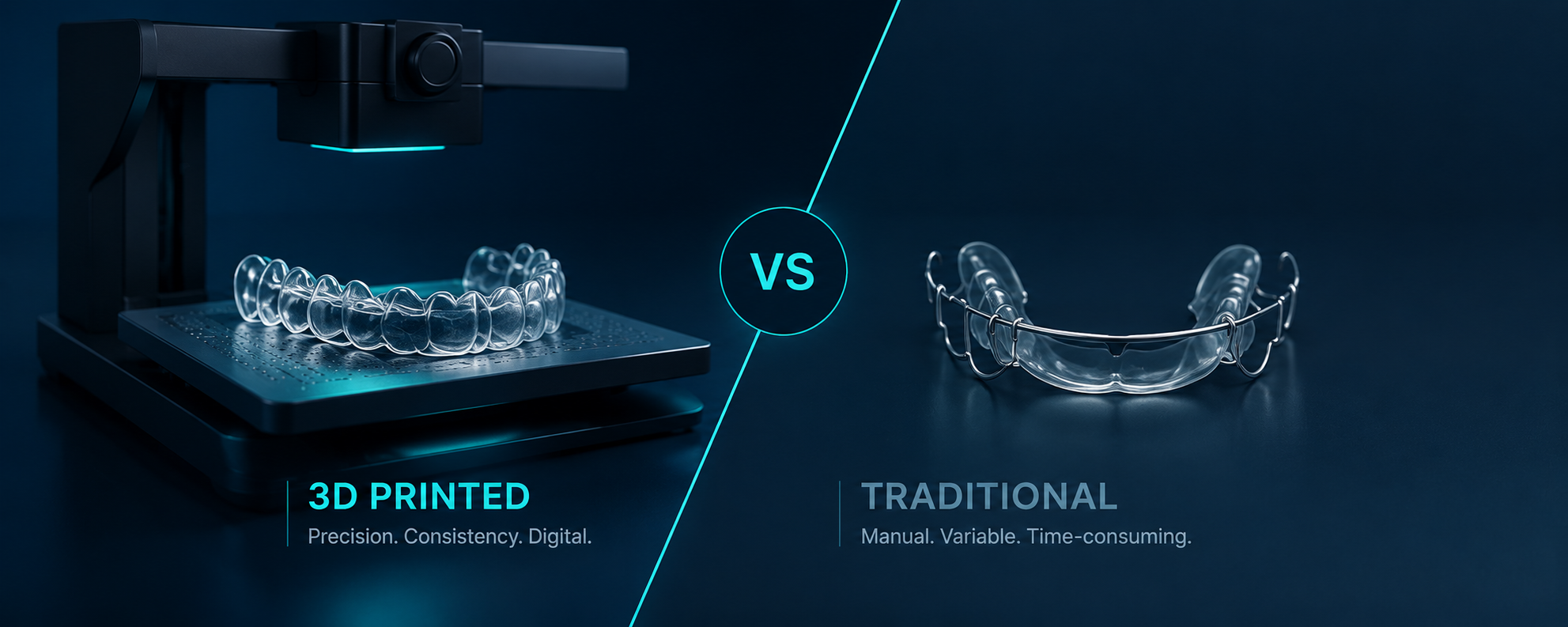
Physical impression → Plaster model → Manual fabrication → Shipping → Delivery. Each step adds time, handling and potential for distortion.
Digital Workflow
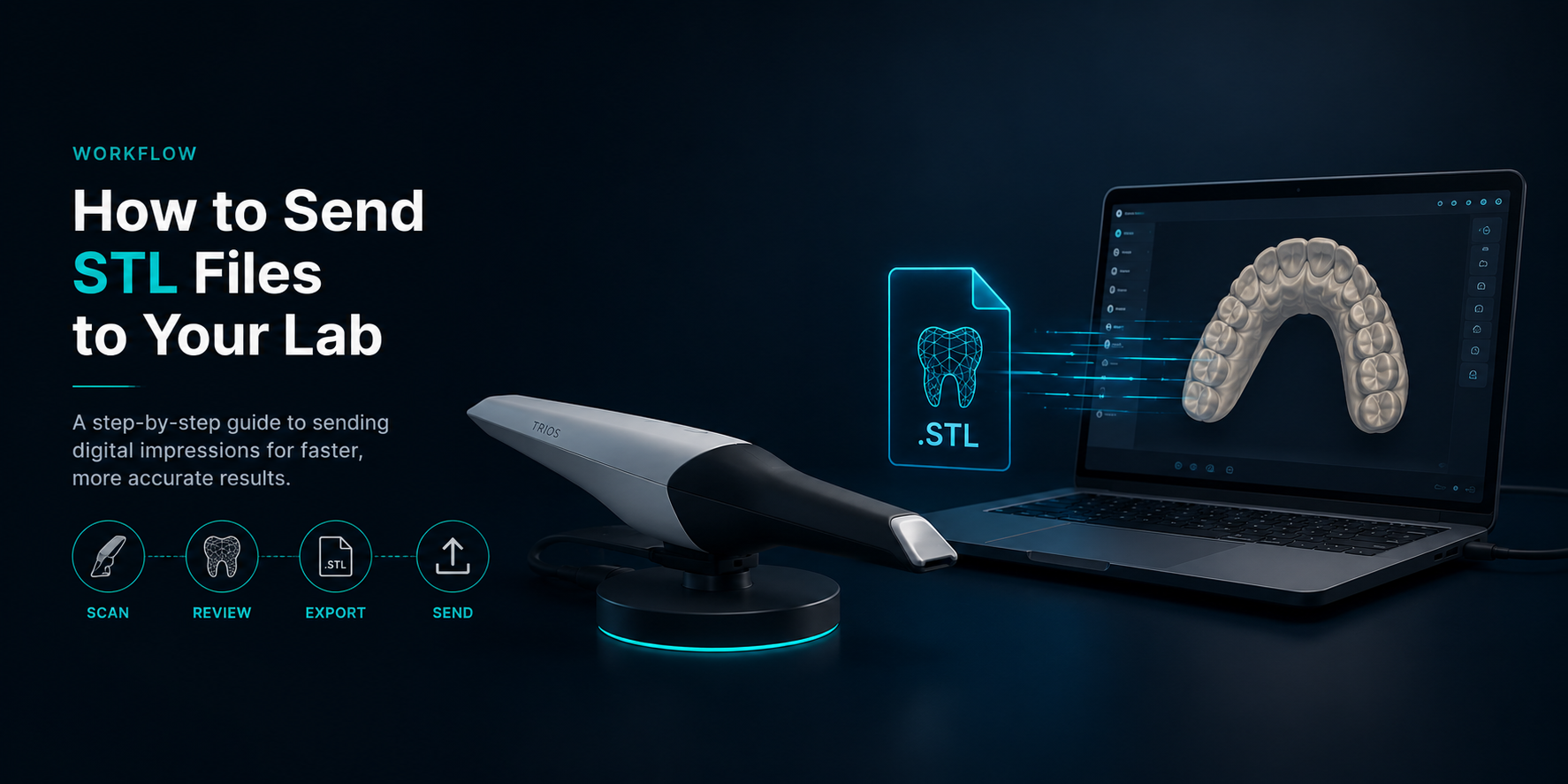
Intraoral scan → STL file → CAD design → 3D printed model → Precision thermoforming or wire bending. Faster, more consistent and fully traceable.
How 3D Printed Retainers Are Made
At Stunning Dental Lab, 3D printed retainers begin with an intraoral scan — no physical impression required. The STL file is imported into 3Shape's CAD software, where our team designs and verifies the digital model before printing on SprintRay's high-resolution resin printers.
For removable retainers, the printed model is used as the thermoforming base — producing a retainer with surface accuracy measured in microns. For bonded retainers, the digital model guides precise wire adaptation, ensuring consistent contact across all anchor teeth.
Side-by-Side Comparison
| Factor | Traditional | 3D Printed |
|---|---|---|
| Fit Accuracy | Variable — depends on impression quality and plaster pour | Consistently high — based on digital scan data |
| Turnaround Time | 5–10 business days incl. shipping | 1–3 business days from STL receipt |
| Patient Experience | Impression discomfort, gag reflex | Scan-only, no impression material |
| Remake Rate | Higher — impression errors common | Lower — digital models are verified before print |
| Model Storage | Physical storage required | Digital archive — retrievable anytime |
| Material Options | Limited by lab materials | Multiple resin types, biocompatible certified |
| Cost | Lower upfront if scanner not available | Requires intraoral scanner investment |
When to Choose Which
3D Printed is the better choice when:
- Your clinic already uses an intraoral scanner (3Shape TRIOS, Medit, iTero)
- Turnaround time is a priority for your patients
- You want a digital archive of every patient's case
- Remake reduction is important to your clinical workflow
- You're treating patients with strong gag reflexes
Traditional methods may still apply when:
- Your clinic hasn't yet invested in digital scanning
- The case involves complex anatomy that benefits from a physical model
- Patient or insurance constraints make the traditional route necessary
Clinical insight: In our experience, clinics that switch to a fully digital retainer workflow see a significant drop in remakes — not because the retainers themselves change dramatically, but because the digital chain eliminates the most common failure points: impression distortion, model breakage and shipping damage.
The Fit Question — Does It Really Matter?
The short answer is yes, significantly. A retainer that doesn't fit precisely doesn't retain. Patients report discomfort, stop wearing it, and treatment outcomes are compromised. The marginal accuracy of a 3D printed retainer — produced directly from a verified digital scan — consistently outperforms a retainer fabricated over a plaster model that may have already shrunk 0.1–0.2%.
For bonded retainers especially, the wire must contact every anchor tooth with consistent force. Gaps in contact — even micro-gaps — can lead to de-bonding, tooth movement and patient callbacks. Our digital wire workflow eliminates this variability.
Our Recommendation
If your clinic has the digital infrastructure in place, there's no clinical argument for choosing traditional over digital retainer fabrication. The results are more predictable, the process is faster, and both you and your patients benefit from a cleaner, more efficient workflow.
If you're in the process of transitioning, we can work with both methods — and we're happy to support your team through the shift to fully digital orthodontic production.